Image Generation

AI-powered tools for creating, editing, and manipulating images

All

Image Generation

58 listings
Flair.ai

Flair.ai

Flair.ai is an AI product photo generator and editor built for e-commerce brands that need studio-quality imagery without photo shoots. Users upload product photos and generate polished visuals: on-model photography that places products on AI-generated human models, instant image generation without model training, background regeneration and modification, and AI-assisted editing and refinement of existing shots. The platform goes beyond stills. It can generate product videos with AI, automatically create advertising creative, and apply brand-level customization โ€” brand asset management in one place, custom backgrounds and props, and a human builder for creating and customizing virtual models to keep every asset on brand. For teams, Flair.ai offers real-time collaboration and API access for integrating generation into existing workflows. The feature set positions it as a production tool for catalogs and campaigns rather than a casual image toy: train custom models on your own products for consistency, generate lifestyle scenes, refresh seasonal backgrounds, and produce ad variants at scale. Flair.ai suits e-commerce marketers, direct-to-consumer brands, marketplace sellers, and agencies managing product catalogs who want faster, cheaper creative production than traditional photography. Its strength is the e-commerce-specific workflow โ€” model imagery, backgrounds, video, and brand controls in one place. Pricing and plan details are listed on Flair.ai's site; specific prices were not shown on the pages reviewed. The platform also supports custom model image generation, where images are created with models trained specifically on a user's own products, improving consistency across a catalog. A human builder lets brands create and customize virtual human models, while custom backgrounds and assets can be uploaded to match a brand's exact look. Team collaboration features allow multiple people to work together in real time, and API access enables integration into larger production pipelines.

Pebblely

Pebblely

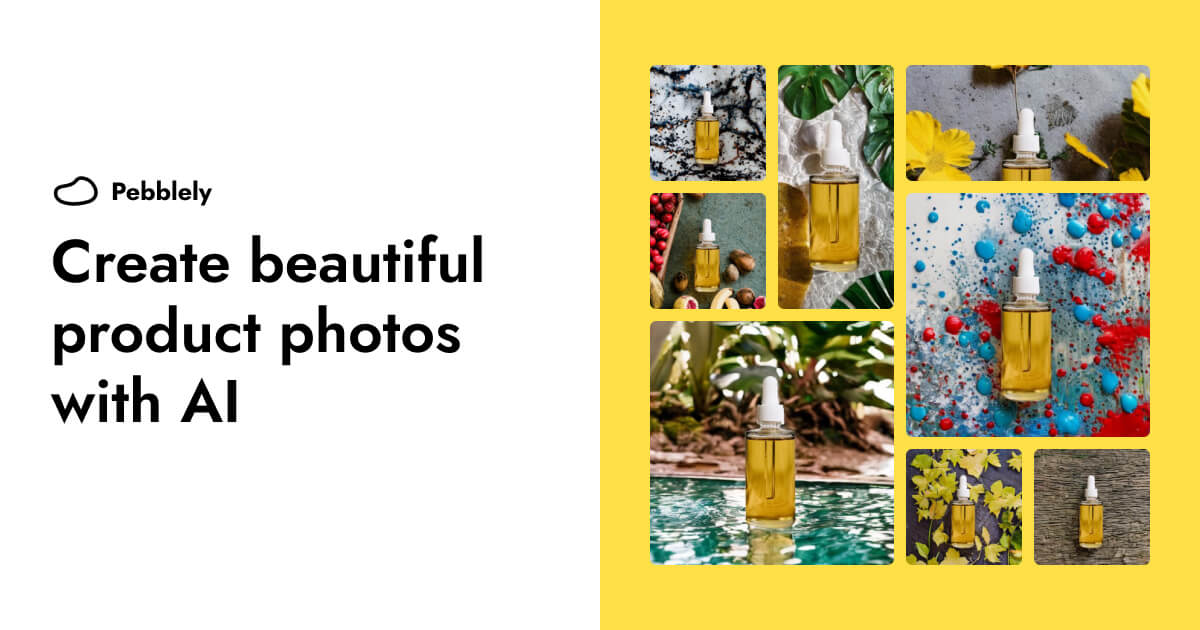
Pebblely is an AI product photography tool that turns basic product shots into polished, professional-looking images in seconds, with no Photoshop skills required. You upload a photo of your product, and Pebblely places it into attractive, on-brand scenes, making it a shortcut to studio-quality e-commerce imagery without the cost or scheduling of a real photoshoot. The platform ships with more than 100 templates to start from: products emerging from rippling water, standing on wooden tables or silk, floating in styled rooms, or worn by models in lifestyle shots, spanning categories like skincare, jewelry, candles, furniture, and pet products. A bulk generation mode produces sets of photos with similar or varied backgrounds, which helps sellers keep a consistent look across large catalogs as their businesses grow. Pebblely says more than a million creatives use the platform, and its published testimonials lean heavily on small sellers: Etsy jewelry shops report stronger sales after swapping staged stand photos for Pebblely-generated lifestyle images, while brands cite better engagement on Instagram ads compared with graphics made in general-purpose design tools. That positions it squarely for e-commerce founders, marketplace sellers, and small agencies that need a high volume of convincing product visuals on a tight budget. The homepage does not display pricing, so check their site for current plans. The workflow is deliberately simple: upload a source image, pick or describe a scene, and download the result, which means sellers without any design background can produce consistent catalog imagery. For agencies, the same speed makes it possible to deliver client-ready lifestyle shots without booking studio time. As an AI product photography generator focused on helping sellers scale content, Pebblely is a practical pick for anyone whose product photos are the bottleneck in their store or ad creative.

Kandinsky 4.0

Kandinsky 4.0

Kandinsky is an open-source text-to-image generation model family developed by Sber's ai-forever research team, named after the painter Wassily Kandinsky. The listing points to the Kandinsky-2 GitHub repository, which documents the 2.0, 2.1, and 2.2 releases under the Apache 2.0 license. A defining trait of the Kandinsky line is multilingualism: the models use multilingual text encoders such as mCLIP-XLMR and mT5, and were trained on large multilingual image-text datasets, so prompts can be written in languages beyond English โ€” including Russian, as shown in the repo's examples. The supported inference modes cover the core editing workflows: text-to-image, image-to-image, inpainting, outpainting, and image fusion, which blends multiple images and text prompts into one output. Version 2.2 added a stronger CLIP-ViT-G image encoder for more aesthetic output and ControlNet support for guided, controllable generation, while earlier versions combined a diffusion image prior with a latent diffusion U-Net. Kandinsky is aimed at developers and researchers rather than casual users: it ships as a Python package with Jupyter notebook examples, Colab notebooks for inference and LoRA fine-tuning, and checkpoints on Hugging Face. A public demo runs on fusionbrain.ai for those who want to try it without setup. The listing names the model 'Kandinsky 4.0,' but the linked repository documents the 2.x line, so version-4.0-specific features could not be verified from the given URL. Kandinsky fits multilingual creators and builders who want an open, hackable image model with inpainting and fusion workflows. Developers comfortable with PyTorch and diffusers will find it straightforward to integrate into existing image pipelines.

HunyuanDiT

HunyuanDiT

HunyuanDiT is Tencent Hunyuan's open-source text-to-image diffusion transformer, designed from the start for bilingual generation in both English and Chinese. It pairs a diffusion transformer backbone with two text encoders โ€” a bilingual (English and Chinese) CLIP and a multilingual T5 encoder โ€” and the research team built the training data pipeline from scratch, including a multimodal language model that refines raw image captions for better text-image alignment. The model's defining capability is fine-grained Chinese understanding: in the project's own human evaluation with more than 50 professional evaluators, it set a new state of the art in Chinese-to-image generation among open-source models, handling categories such as ancient Chinese poetry and Chinese cuisine with strong image quality and semantic accuracy. It supports prompts up to 256 tokens, generates at multiple resolutions, and can carry on multi-turn multimodal dialogue with users โ€” generating and then refining images across conversation turns so creators can iterate conversationally. HunyuanDiT also ships ControlNet plugins covering canny edges, depth, and human pose, plus newer tile, inpainting, and lineart plugins for high-definition zoom up to 4K and 8K, image restoration and expansion, and line-drawing-to-image workflows suited to architectural renderings and coloring sketches. Code and pretrained checkpoints are publicly available through the project's GitHub repository and Hugging Face. It suits developers and creators who need Chinese-language prompts and culturally accurate imagery, e-commerce and design teams doing bilingual creative, and researchers studying multilingual text-to-image models. Note the hunyuan.tencent.com page had no readable content at research time; the description is drawn from the project's documentation and paper.

Kolors

Kolors

Kolors is a large-scale text-to-image model developed by the Kuaishou Kolors team and released as open source. Built on latent diffusion, it was trained on billions of text-image pairs and stands out for bilingual capability: unlike models built on the T5 language model, Kolors is built on the General Language Model (GLM), giving it strong comprehension in both Chinese and English โ€” including accurate rendering of Chinese and English text inside images and an understanding of Chinese-specific content. The model is tuned for photorealistic, high-resolution output with advanced semantic understanding, able to handle complex prompts involving multiple entities, and it supports both text-to-image and image-to-image generation through its diffusers pipeline. Kuaishou reported that Kolors scored 75.23 in an evaluation by the Beijing Academy of Artificial Intelligence, ranking near the top globally among text-to-image models, and the accompanying technical report cites human evaluations placing its visual appeal at the level of Midjourney v6. Developers can access Kolors through the Kwai-Kolors organization on Hugging Face, with a diffusers integration and a published technical report and GitHub repository containing code and weights. Suggested starting settings use a guidance scale of 5.0 with 25 to 50 inference steps. Kolors fits developers, researchers, and creators who need strong Chinese-language image generation or an open, inspectable alternative to closed commercial models. Its combination of bilingual text rendering and photorealism makes it especially useful for Chinese-context creative and commercial work. The diffusers quickstart recommends the EulerDiscreteScheduler with a guidance scale of 5.0 and 50 inference steps, or the EDMDPMSolverMultistepScheduler with 25 steps, and the pipeline supports both text-to-image and image-to-image generation.

Wurstchen v3

Wurstchen v3

Wurstchen is an open-source text-to-image diffusion architecture developed by researchers including Pablo Pernias and collaborators, notable for doing more with far less compute. Its novel three-stage design learns an extremely compact semantic image representation, a semantic compressor, that guides two latent diffusion stages, with a VQGAN decoder producing the final full-resolution image. Because the heavy text-conditional diffusion runs in this strongly compressed latent space, the team trained a 1-billion-parameter model in roughly 24,600 GPU hours, about an eighth of what Stable Diffusion 2.1 required, while matching it on fidelity and running inference more than twice as fast. The "v3" in this listing's name corresponds to Stable Cascade, Stability AI's successor built on the Wurstchen approach: a hierarchical three-stage latent diffusion model using extreme compression for fast, memory-efficient generation, released with open weights for non-commercial use. Code and weights for the original Wurstchen are publicly released, and a Hugging Face diffusers pipeline exists, though it is now marked deprecated. Wurstchen suits researchers and developers who care about efficient training and deployment of image models, proof that careful architecture can democratize high-quality synthesis. For practitioners, the practical takeaway is accessibility: training and running strong image models without a supercomputer budget. The paper's user-preference studies reported that participants favored Wurstchen's output quality, supporting the claim that efficiency did not come at the cost of fidelity. Stable Cascade carries the idea further with its hierarchical staging, separating compression, structure, and detail phases so each can be tuned independently. Note: the listed site wuerstchenai.com is unreachable; these details come from the published research paper and Hugging Face documentation rather than a live product page.

DeepFloyd IF

DeepFloyd IF

DeepFloyd IF is an open-source text-to-image model from Stability AI's DeepFloyd research lab, built on a cascaded pixel-diffusion architecture rather than the latent diffusion most image models use. The model works directly in pixel space through three stages: a base model that generates a 64-pixel image from the text prompt, a super-resolution stage that upscales it to 256 pixels, and a final stage reaching 1024 pixels using Stability AI's x4 upscaler. Its signature strength is rendering legible, correctly spelled text inside generated images โ€” a breakthrough when it launched โ€” making it useful for logos, posters, signage, memes, and any design where the wording matters. Prompt understanding is powered by a frozen T5-XXL language model as the text encoder, with cross-attention layers that align complex prompts and spatial relationships such as a red cube on top of a pink sphere. The model achieved a zero-shot FID score of 6.66 on the COCO benchmark and supports non-standard aspect ratios, including vertical and horizontal formats. DeepFloyd IF also supports zero-shot image-to-image translation: it can restyle an existing image, alter patterns and details, or upscale external images while preserving the source's essence, plus masked inpainting for targeted edits. The weights are gated on Hugging Face under the DeepFloyd IF License Agreement, which permits non-commercial research use. It suits researchers, designers, and developers who need typography-accurate open-source image generation or pixel-space control. Note that deepfloyd.ai no longer resolves, so the Hugging Face model pages and the project's GitHub repository are the working references. For text-heavy generation tasks, DeepFloyd IF remains one of the most capable open options.

Amazon Nova

Amazon Nova

Note for the directory editors: the listing URL now resolves to Amazon Nova, Amazon's current foundation-model family, which has superseded the Amazon Titan branding โ€” the description below covers Nova as presented on the official AWS page. Amazon Nova is Amazon's portfolio of AI offerings on AWS, positioned as fast, cost-effective foundation models with enterprise-grade safeguards. The lineup includes the Nova models themselves โ€” described as delivering strong intelligence with industry-leading price-performance for text and multimodal workloads โ€” alongside two services: Nova Forge, which lets organizations build their own frontier models without training from scratch, and Nova Act, which builds and manages fleets of AI agents that automate browser-based UI workflows such as computer use. The models are built on AI technology originally developed for Amazon's own applications, including Alexa+, Amazon Ads, the Amazon catalog system, AWS Marketplace, and Amazon Stores, and are now available to AWS customers. Amazon reports adoption by tens of thousands of customers across industries, citing productivity, automation, and cost-saving gains in real deployments. The platform includes built-in controls for safe and responsible use, with content filters and policy-aligned behavior aimed at meeting compliance requirements. Nova is aimed at developers and enterprises building AI experiences on AWS โ€” from chat and multimodal applications to custom model development and UI automation agents โ€” particularly teams already invested in the AWS ecosystem. New AWS customers can try AWS AI with up to $200 in AWS credits. Full model and pricing details are on the AWS site. Amazon also highlights what it calls the most comprehensive customization capabilities of any proprietary model family, letting organizations tailor responses to their needs.

Playground v3

Playground v3

Playground is a free AI design studio built for people who want professional-looking creative output without design experience. Positioned around the promise that you can turn any idea into stickers, merch, posters, logos, t-shirts, and social media graphics, it targets creators, small businesses, and marketers who need finished visuals fast. Rather than training its own model, Playground plugs in several of the strongest image AIs available, including GPT Image 2, Nano Banana Pro, and Seedream, and puts them all in one place, free to start. A particular strength is typography: the tool produces crisp headlines, legible body copy, and layouts that feel designed rather than generated, which matters for posters, packaging, invitations, and ads where garbled text usually gives AI art away. The company says it is trusted by more than 13 million creators across 120 countries, and the pitch is end-to-end practicality: start free with no credit card required and go from idea to print-ready designs in days. That makes it a natural fit for print-on-demand sellers, event organizers, and social media managers producing a steady stream of graphics, as well as anyone who has bounced off complex design software in the past. One caveat for directory readers: the listing name "Playground v3" refers to Playground's earlier image-model lineage, but the current site presents a repositioned design-studio product rather than a standalone model release, and the description above reflects what the site shows today. For no-cost, no-experience design creation with modern image models under the hood, it is an easy one to try.

AuraFlow

AuraFlow

AuraFlow is an open-source text-to-image generation model developed by researcher Simo (cloneofsimo) in collaboration with Fal.ai, built as a fully open, flow-based alternative to proprietary image generators. The listing's auraflow.com domain no longer resolves, so this description is based on the model's Hugging Face documentation and independent coverage rather than a live product site. The latest documented release, AuraFlow v0.3, was trained with more compute than its predecessors, fine-tuned on more aesthetic datasets, and supports a range of aspect ratios with width and height up to 1,536 pixels. The model is reported to achieve state-of-the-art results on the GenEval benchmark. Independent comparisons describe AuraFlow as particularly strong at impressionistic, fantastical, and whimsical styles โ€” the fantasy-environment use case this directory notes โ€” while noting that rivals like Stable Diffusion 3 Medium render more detailed, hyper-realistic scenes. It is released under the Apache 2.0 license, which allows free use, modification, and commercial distribution, making it attractive to developers and fine-tuners. The main practical caveat is hardware: reviews report AuraFlow can demand as much as 35 GB of VRAM to run locally, far more than lighter open models, so most users will run it through a hosted API or quantized version rather than on a consumer GPU. AuraFlow fits developers, researchers, and hobbyists who want a genuinely open-source image model for fantasy and stylized art, and who are comfortable working from model cards and community tooling rather than a polished consumer app. Those who prefer not to self-host can try the model through Fal's online playground or community-run demos.

PixArt-Sigma

PixArt-Sigma

PixArt is an open-source family of transformer-based text-to-image diffusion models built to deliver commercial-grade quality at a fraction of the training cost of large rivals. The project page documents PixArt-alpha, whose stated design goal was image generation quality competitive with Imagen, SDXL, and Midjourney while keeping training costs dramatically lower โ€” the researchers report about 10.8% of Stable Diffusion v1.5's training time, roughly $26,000 versus $320,000, and 90% lower CO2 emissions, using only around 1% of the training cost of the larger RAPHAEL model. The model is a diffusion transformer (DiT) that injects text conditions through cross-attention, and it supports high-resolution synthesis up to 1024 pixels. The project provides an online demo, plus sample galleries showing photorealistic scenes, stylized art, and controlled generations. It also supports customization workflows: ControlNet integration for edge- and pose-guided generation and DreamBooth-style personalization, so users can teach the model their own subjects and styles from a few images. The three-stage training design separately optimizes pixel dependency, text-image alignment, and aesthetic quality, which the researchers credit for reaching near-commercial quality at such a small training budget. PixArt fits researchers and developers who want to study, fine-tune, or build on an open text-to-image model without enterprise compute budgets, startups prototyping generative features, and hobbyists generating art locally. Note that the project URL (pixart-alpha.github.io) documents the PixArt-alpha release; PixArt-Sigma is the follow-up iteration in the same family, so readers should check the project page for the latest checkpoints. For teams weighing open image models, PixArt's training-efficiency story is its main attraction.

SDXL Turbo

SDXL Turbo

SDXL Turbo is a real-time text-to-image model from Stability AI that compresses the diffusion process into a single step. Where traditional diffusion models need dozens of sampling steps to produce an image, SDXL Turbo uses a technique called Adversarial Diffusion Distillation to generate high-fidelity 512x512 images in one forward pass โ€” as fast as about 207 milliseconds on a high-end GPU like the NVIDIA A100, fast enough that images appear to render as text is typed. Unlike pure GAN approaches, it can still refine results over a few additional steps, matching the quality of models that need 16 to 50 steps. The model weights and code are distributed openly through Hugging Face and Stability AI's generative-models GitHub repository, and it integrates with popular local toolchains including ComfyUI and Automatic1111. For users who do not want to run it locally, it is also available through Stability AI's Clipdrop web interface. Because of its speed, SDXL Turbo is well suited to interactive and real-time applications: video games, virtual reality, rapid design prototyping, and instant content creation for social media and marketing. It is also a practical educational and research tool for studying advanced image synthesis. Reviewers note it can struggle with legible text, faces, and highly complex scenes, and that prompt specificity affects output quality. The model has been released under a non-commercial research license for personal and research use, so commercial deployment requires separate licensing from Stability AI. Stability AI's Clipdrop web interface makes the model accessible without any local setup, and independent playgrounds have also offered free trial generations during the beta period. Because the weights are public, developers can integrate SDXL Turbo into their own applications and experiment with its single-step synthesis pipeline.

AI image-generation tools can support art, product imagery, design, photorealism, and image editing. Use this directory to compare products by their stated workflow, then verify current capabilities and terms on each linked official source.

How to evaluate image-generation tools

  • Define the output first: concept art, product imagery, design assets, photorealistic scenes, or editing.
  • Test representative prompts and source images, then review consistency, controls, export options, and human review needs.
  • Check usage rights, privacy, model or training policies, integrations, and plan terms before adopting a tool.

This category is an organized starting point, not a ranking or endorsement. Product details and availability can change, so review the official source linked from each listing. For a broader directory overview, see the Best AI Tools 2026 guide.

For a focused comparison of image-generation workflows, read Midjourney vs DALL-E vs FLUX.